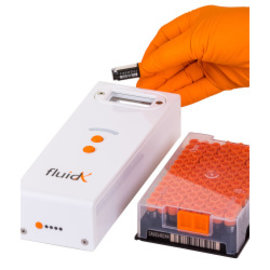

Barcode readers optically capture barcodes for fast and error-reduced data entry. They are used in laboratories for efficient sample or material identification.
The following suppliers offer Barcode reader products.
You can send a request to the suppliers listed above and save time. Describe your requirements and the request will be forwarded to the selected suppliers. They will contact you with suitable proposals without any obligation.
Barcode readers are primarily used in laboratories for the automated capture of barcode data on samples or consumables. Using optical sensors, they recognize various barcode types and convert these signals into digital information.
When selecting a device, attention should be paid to compatibility with the barcode format in use, the connection type to the laboratory information system, as well as ergonomics and reading range. Durability in daily laboratory use can also be important.
LabFinder helps you navigate by providing a collection of various barcode reader types with detailed technical specifications, making procurement easier and helping to reduce inefficiencies in data capture.
Barcode readers are used in laboratories to automatically capture information from optically detected barcodes. Typical applications include the identification of samples, consumables, and laboratory equipment. This streamlines data management, reduces the risk of errors, and speeds up processes in sample logistics, documentation, and quality control.
When choosing a barcode reader, key factors include the supported barcode format (e.g., 1D barcode, 2D Data Matrix), handling (stationary or handheld), and interfaces (USB, Bluetooth, WLAN). Other aspects are scanning speed, reading range, compatibility with existing IT systems, and suitability for the laboratory environment regarding cleaning and ease of use.
Barcode readers use red or infrared light to optically detect barcode reflections. Typical devices include stationary scanners, handheld scanners, or integrated modules in automated systems. The decoding of barcodes is based on optical pattern recognition and digital signal processing.
Barcode readers generally do not require extensive calibration, as the optical systems are factory-set. It is important to regularly clean the optics and surfaces since dirt can reduce detection rates. Software updates can improve decoding performance and add support for new barcode formats.
Barcode readers depend on clean, undamaged, and clearly visible barcodes. Faded or reflective labels can make detection difficult. Additionally, they are generally not suitable for automatic detection of free text and are limited to barcode formats.
Synonyms and related terms include barcode scanner, barcode reader, barcode scanner device, optical barcode scanner, handheld barcode scanner, scanner barcodes, barcode capture system. These terms are often used interchangeably and can help find relevant products.
A barcode reader uses optical sensors and light sources (red or infrared light) to detect the black and white elements of a barcode. The captured signals are digitally decoded and transmitted to connected systems for automated information capture.
Modern barcode readers can capture both one-dimensional barcodes (1D) and two-dimensional codes (2D), such as Data Matrix or QR codes. The exact capabilities depend on the model and should be matched to the barcode formats used in the laboratory.
Key factors include compatibility with the barcode types used, connection options (e.g., USB, wireless), user comfort, reading range, and suitability for the laboratory environment, including ease of cleaning and robustness.
Regular cleaning of the scanner optics and barcode labels is important to maintain detection rates. Software updates can improve decoding functions. Manual calibration is usually not required.
Barcodes must be clean, undamaged, and have good contrast to be read correctly. Highly reflective or damaged labels can hinder detection. Barcode readers cannot read free text or handwriting.
Present your company on LabFinder and be listed for this product category as well as suitable related categories and brands.