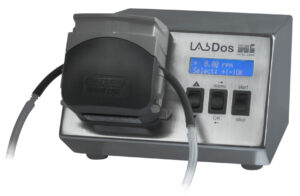

Peristaltic pumps transfer liquids by mechanically compressing a tube. They are suitable for precise and contamination-free dosing and transfer tasks in the laboratory.
The following suppliers offer Pumps - Peristaltic pump products. Use the overview to compare suitable companies, brands and related product categories and send a direct request.
You can send a request to the suppliers listed above and save time. Describe your requirements and the request will be forwarded to the selected suppliers. They will contact you with suitable proposals without any obligation.
Peristaltic pumps are primarily used in laboratories for the precise delivery and dosing of liquids, especially when a contact-free transfer process is required. This pump type is well suited for sensitive and sterilizable media as the liquid only comes into contact with the tubing. When selecting a pump, tubing material, flow rate, and compatibility with the medium are key factors. Flow accuracy and tubing wear are important criteria for instrument use and maintenance planning. LabFinder assists users by providing clear classification, usage guidelines, and matching products from the pumps and dosing systems sector in alignment with relevant laboratory requirements.
Peristaltic pumps, also known as tube or roller pumps, are positive displacement pumps that transfer liquids via the mechanical compression of a flexible tube. This mechanism enables contact-free conveyance, which is particularly advantageous for sterile or chemically aggressive liquids. Typical areas of use include laboratory applications in analytics, chemistry, biotechnology, and medical technology. These pumps are suitable for precise dosing tasks and can handle liquids with varying viscosities and particle loads.
The selection of a peristaltic pump depends on the medium to be delivered, the required flow rate, and flow accuracy. Tubing materials are crucial, as they must ensure chemical resistance and flexibility. Pump capacity and pressure range should also be considered, as well as the maintenance effort and tubing replacement intervals. For some applications, low pulsation is relevant, along with compatibility with existing laboratory equipment.
Peristaltic pumps mainly vary in the number and arrangement of rollers and type of control. Common variants are roller pumps with one or more rollers, speed regulation, and digital control for precise dosing. Different tubing diameters and lengths allow adaptation to various flow volumes and pressures. Flow measurement principles are typically based on pump speed and tubing geometry, sometimes combined with additional flow meters for control.
Reliable operation requires regular maintenance. The tube is a wearing part and should be checked and replaced according to the recommended intervals. Calibration is usually performed by comparative measurements of flow rate to ensure dosing accuracy. Simple disassembly of components facilitates cleaning and minimizes maintenance time.
Peristaltic pumps are not suitable for gases or highly abrasive media, as the flexible tubing can be damaged. They are limited in terms of maximum pressure and flow rate, which must be considered for large-volume or highly viscous liquids. In addition, pulsation in the flow may occur depending on the number of rollers and pump type, which can affect process quality in certain applications.
Synonyms and related terms for peristaltic pumps include tube pump, tube compression pump, roller pump, recirculating piston pump, and displacement tube pump. Other keywords are fluid conveyance, dosing pump, laboratory pumps, and pump technology, reflecting the wide range of applications and functions of these pumps in the laboratory.
A peristaltic pump transfers liquids by mechanically compressing a flexible tube with rollers or wheels, pushing the medium through the tube via a squeezing action—meaning the liquid only comes into contact with the tubing.
There are various types differing mainly in the number and arrangement of rollers, control methods (manual, electric, digitally regulated), and tubing sizes to cover different flow rates and pressures.
Important factors include the chemical compatibility of the tubing material with the medium, the desired flow rate, operating pressure, and ease of maintenance—including tubing replacement intervals.
The tubing is a consumable part and should be checked and replaced regularly depending on the medium, operating hours, and load, to ensure consistently precise delivery.
Peristaltic pumps are not ideal for transferring gases or highly abrasive media, as these can damage the tubing. They are also limited by certain pressure and flow boundaries.
Present your company on LabFinder and be listed for this product category as well as suitable related categories and brands.