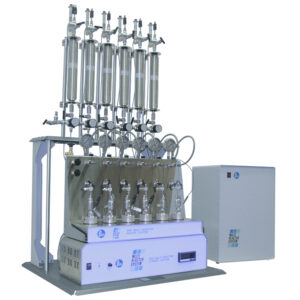

Vacuum filtration efficiently purifies liquids by applying negative pressure and membrane filters. It enables rapid filtration and sterilization of laboratory samples.
The following suppliers offer Vacuum filtration products.
You can send a request to the suppliers listed above and save time. Describe your requirements and the request will be forwarded to the selected suppliers. They will contact you with suitable proposals without any obligation.
Vacuum filtration is used to purify liquids using negative pressure, forcing them through a membrane. It is mainly employed to remove unwanted solid particles and obtain sterile samples. Key selection criteria include the type of membrane, the volume of liquid to be filtered, and the required filtration level. In laboratories and research facilities, LabFinder aids in the targeted search for vacuum filtration devices and suitable materials, simplifying the procurement of appropriate solutions for sample preparation.
Vacuum filtration is primarily used in laboratories and research environments to reliably remove solid impurities from liquids and contribute to sterilization. The medium is placed into a special funnel vessel and passed through a filter membrane by creating a vacuum. In this way, samples can be prepared quickly and effectively, also for microbiological or analytical investigations.
The selection of suitable vacuum filtration systems depends on the type of sample, desired filter fineness, and compatibility with different membrane types (e.g., cellulose, nylon, PTFE). The size of the filtration system and the performance of the vacuum pump also play a role. Additionally, handling and cleaning options should be considered to optimize laboratory workflow.
Vacuum filtration systems exist as simple manual vacuum filtration setups as well as more complex apparatuses with pumps of varying capacities. Filtration is carried out using membrane filters with different pore sizes suited to the application—such as clarification or sterile filtration. The principle is based on the vacuum generated, which pulls the liquid through the filter membrane.
Vacuum filtration devices do not require calibration in the strict sense, as they operate according to physical principles. Proper maintenance includes regular cleaning of equipment, replacement of membrane filters after use, as well as checking the system for leaks and ensuring the functionality of the vacuum pump for reliable operation.
Vacuum filtration is limited to liquids and is not suitable for separating gases or solid mixtures without liquids. Filtration depends on membrane pore size; very small particles or dissolved substances may not be retained and require different procedures. Additionally, the method is not always suitable for highly viscous or aggressive media, as the membrane can be damaged.
To improve findability, search terms include vacuum filtration, negative pressure filtration, filtration with vacuum, sterile filtration, laboratory filtration, membrane filtration, as well as vacuum pump and filtration apparatus.
In vacuum filtration, liquid is drawn through a filter membrane by applying negative pressure, causing impurities to be retained and the medium to be purified.
Depending on the application, various filter materials such as cellulose, nylon, or PTFE with different pore sizes are used to meet specific filtration and sterilization requirements.
Important factors include filtration capacity, sample compatibility, membrane type, vacuum pump performance, as well as easy handling and maintenance options.
Yes, with appropriate membranes and controlled operation, this method can quickly render non-sterile samples sterile.
The method is suitable only for liquids and is limited with highly viscous or aggressive media. Very fine dissolved substances are not retained and require alternative methods.
Present your company on LabFinder and be listed for this product category as well as suitable related categories and brands.